
Pakistan Petrol Prices Shock Increase by Rs55 Per Litre
In a startling development that sent shockwaves across the nation, the Government of Pakistan announced a massive increase of Rs55 per litre in the prices of both petrol and high-speed diesel on Friday, March 6, 2026 . This represents one of the steepest single hikes in the country’s history, with Pakistan petrol prices now at Rs321.17 per litre and diesel at Rs335.86 per litre .
The announcement was made by Petroleum Minister Ali Pervez Malik at a press conference in Islamabad, flanked by Deputy Prime Minister and Foreign Minister Ishaq Dar and Finance Minister Muhammad Aurangzeb . The new Pakistan petrol prices took effect from midnight (12:00 AM) on March 7 .
Pakistan Petrol Prices : The New Prices at a Glance
Product Old Price (Rs/Litre) New Price (Rs/Litre) Increase
- Petrol 266.17 321.17 +Rs55
- High-Speed Diesel (HSD) 280.86 335.86 +Rs55
This represents a percentage increase of approximately 17% for petrol and 20% for diesel , making it one of the most significant price adjustments in Pakistan’s economic history . The hike in Pakistan petrol prices will have far-reaching implications for the economy and common citizens.
Read Also Here: Petrol Price in Pakistan Today Drops by Rs2.07 per Litre
Why the Shocking Increase?
Regional Conflict and Global Oil Prices
The primary driver behind this unprecedented hike is the escalating conflict in the Middle East, specifically the ongoing war between US-Israel and Iran . The situation intensified dramatically after Iran announced the closure of the Strait of Hormuz , a critical global energy route through which approximately one-fifth of the world’s seaborne crude oil passes .
Speaking at the press conference, Petroleum Minister Ali Pervez Malik explained the gravity of the situation:
“The fire that started in a neighbouring country has spread across the region. There is no clear timeline for when the crisis will end. We are facing extraordinary circumstances” .
Deputy Prime Minister Ishaq Dar added that global oil prices have surged by an estimated 50 to 70 percent due to the ongoing conflict, leaving the government with little choice but to pass on some of this burden to consumers. This has directly impacted Pakistan petrol prices which are now at record levels.
Shift to Weekly Price Reviews
In response to the volatile situation, the government announced a significant policy shift—moving from the traditional fortnightly price reviews to weekly reviews . This change will allow the government to respond more quickly to fluctuations in international markets and potentially ease Pakistan petrol prices when conditions improve.
“We will now examine fuel prices every week and will lower them as soon as conditions in the global market stabilise,” Malik assured the public .
Adjustments in Petroleum Levy
To partially offset the impact of the price hike, particularly on diesel which fuels heavy transport and agriculture, the government adjusted the Petroleum Development Levy (PDL) structure :
Product Old Levy (Rs/Litre) New Levy (Rs/Litre) Change
- Petrol 84.40 105 +20.60
- High-Speed Diesel 76.21 55 -21.21
This strategic adjustment means the government is effectively collecting less tax on diesel to cushion the blow for the transport and agricultural sectors, while increasing the levy on petrol which is primarily used in private transport. This nuanced approach aims to soften the impact of rising Pakistan petrol prices on the most vulnerable sectors.
Public Reaction: Panic Buying and Long Queues
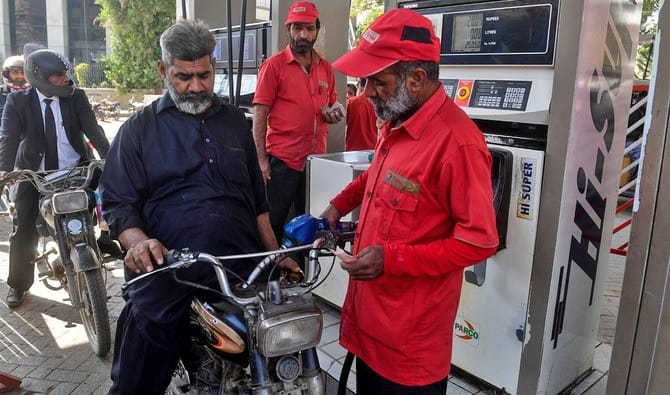
Ahead of the midnight price change, long queues formed at petrol stations across major cities including Karachi and Lahore , as motorists rushed to refuel before the higher Pakistan petrol prices came into effect .
In some areas, fuel stations temporarily closed their pumps, reportedly to avoid selling stocks at the old prices. Business owner Imran Hussain, waiting in a queue in Lahore for 70 minutes, expressed his concerns: “I have been waiting for my turn for the last 70 minutes. I wanted to be prepared in case of a shortage”.
Government’s Response: Anti-Hoarding Crackdown
Prime Minister Shehbaz Sharif ordered strict action against any disruption by hoarders of petroleum products . The Prime Minister directed that:
- Any petrol pump involved in creating artificial shortages should be immediately closed
- Licences of violating stations should be cancelled
- Legal action should be taken against those involved in illegal profiteering
Petroleum Minister Malik echoed this warning, stating that authorities would move against those attempting to manipulate supply for illegal gains, especially given the sensitive nature of Pakistan petrol prices at this time.
Diplomatic Efforts and Alternative Supply Routes
Engaging Saudi Arabia
Pakistan has approached Saudi Arabia to explore alternative routes for oil shipments after Iran’s decision to shut the Strait of Hormuz . The request was conveyed by Petroleum Minister Malik to the Saudi ambassador to Pakistan, Nawaf bin Said Al‑Malki.
According to Malik, Saudi officials assured Pakistan that oil deliveries could be arranged through the Red Sea port of Yanbu to help fulfil the country’s energy requirements . This could help stabilize Pakistan petrol prices in the medium term.
Current Shipments
Malik informed the public that two vessels operated by the Pakistan National Shipping Corporation are currently transporting oil through alternative routes via Yanbu and Fujairah to maintain supplies .
Fuel Conservation Plan Delayed
Earlier in the day, the government decided to delay a proposed national fuel conservation plan that included work-from-home arrangements and distance learning measures in case of supply disruptions .
The decision was taken at a high-level meeting chaired by Prime Minister Shehbaz Sharif, where officials concluded that existing fuel stocks were sufficient to meet national demand for the time being. The contingency plan had been prepared in consultation with provincial governments and discussed with the International Monetary Fund, but its implementation has been postponed for at least a week .
Economic Implications
Inflation Concerns
The sharp increase in Pakistan petrol prices is expected to ripple through the economy, leading to higher inflation and impacting Pakistan’s already struggling population. The minister himself acknowledged that “the decision is likely to ripple through to higher inflation and hit Pakistan’s impoverished population” .
IMF Context
The price hike comes amid ongoing virtual negotiations between Pakistan and the International Monetary Fund (IMF) regarding energy pricing and fiscal targets. The IMF had reportedly urged Pakistan to immediately increase petrol and diesel prices in line with global market rates and avoid providing any subsidy on petroleum products .
The lender also emphasised the need for Pakistan to achieve its petroleum development levy target of Rs1.468 trillion by June 30 .
Official Statements
- Petroleum Minister Ali Pervez Malik
“We have taken this decision under compulsion because of a sharp surge in petroleum prices globally. We have sufficient petrol reserves. But we are planning to stretch them because we don’t know when the Middle East crises will end” . - Deputy Prime Minister Ishaq Dar
“The entire region was virtually facing war like situation and the conflict in Iran had incurred negative impact on the petroleum prices in the global market. The petroleum prices globally have spiked up” . - Finance Minister Muhammad Aurangzeb
Assured the public that Pakistan currently possesses sufficient petroleum reserves and urged citizens not to panic. He added that the government was carefully analysing how the increase in global oil prices might affect Pakistan’s trade flows, particularly imports and exports .
Analysis by Best Pak Mag
The Rs55 per litre increase in Pakistan petrol prices represents a watershed moment for Pakistan’s economy. This is not merely another routine price adjustment—it is a direct consequence of escalating geopolitical tensions that have fundamentally altered global energy markets. The closure of the Strait of Hormuz, through which a significant portion of the world’s oil passes, has created supply chain disruptions that few countries can escape .
What makes this situation particularly challenging for Pakistan is the confluence of external pressures and internal fiscal constraints. The government finds itself caught between the IMF’s insistence on passing on global price increases to consumers and the domestic reality of an inflation-burdened population . The strategic reduction in the petroleum levy on diesel—from Rs76.21 to Rs55 per litre—demonstrates an awareness that the agricultural and transport sectors, which rely heavily on diesel, cannot bear the full brunt of this shock .
The shift to weekly price reviews is a pragmatic response to unprecedented volatility, but it also introduces new uncertainty for businesses and households accustomed to predictable fortnightly adjustments . As Minister Malik acknowledged, no one knows when this crisis will end.
Pakistan’s diplomatic outreach to Saudi Arabia for alternative supply routes through Yanbu offers a glimmer of hope . If successful, this could insulate Pakistan from future disruptions in the Strait of Hormuz and help stabilize Pakistan petrol prices. However, such alternative arrangements take time to operationalize fully.
For ordinary Pakistanis, the immediate future looks challenging. The long queues at petrol stations in Karachi and Lahore are not just about saving a few rupees—they reflect a deeper anxiety about what comes next . The government’s assurance of sufficient reserves is reassuring, but the psychological impact of such a sharp price hike cannot be underestimated.
As the nation braces for the inflationary ripple effects, one thing is clear: Pakistan’s energy security is inextricably linked to the geopolitics of a volatile region, and navigating this reality will require both diplomatic skill and domestic resilience.
Read More Here: