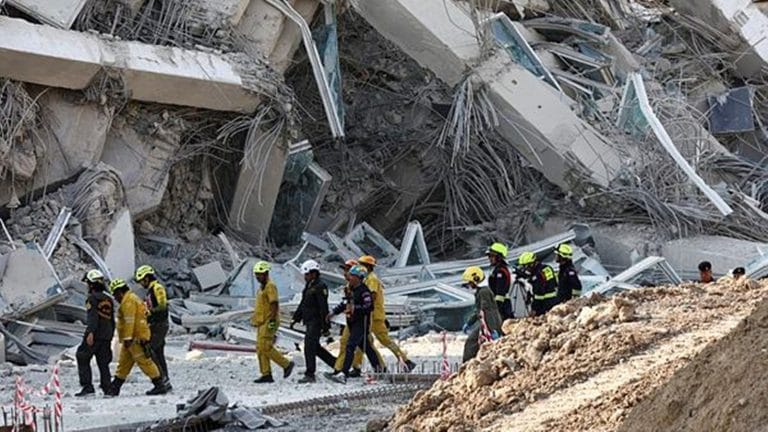


Earthquake Today February 2026 Strong Tremors in Myanmar
Earthquake Today : Several earthquakes rattled different parts of the world on February 25, 2026, with the strongest being a magnitude 5.5 tremor that struck Myanmar’s Kachin State . The seismic activity spanned across Southeast Asia, the Pacific, and even parts of the Himalayas, reminding us of the dynamic nature of our planet’s tectonic plates.
According to the World Earthquake Report compiled by VolcanoDiscovery, a total of 593 earthquakes of magnitude 2 or higher were recorded globally in the past 24 hours . This includes 2 quakes of magnitude 5 or higher, 32 quakes of magnitude 4 or higher, and 142 quakes of magnitude 3 or higher .
Here is a comprehensive roundup of today’s most significant seismic events.
Read Also Here: T20 World Cup 2026 Super 8 Points Table Latest Standings
Strongest Earthquake Today Myanmar Magnitude 5.5
The strongest earthquake recorded today struck Myanmar at a shallow depth of just 1 kilometer . The magnitude 5.5 tremor hit at 10:15 AM local time, with its epicenter located approximately 494 kilometers northwest of Mae Sai district in Chiang Rai, Thailand .
Details of the Myanmar Quake:
Parameter Details
- Magnitude 5.5 M
- Location Kachin State, Myanmar
- Depth 1 km shallow
- Time 10:15 AM local time
- Epicenter 24.369°N, 97.633°E
- Distance from Thailand 494 km NW of Mae Sai district
According to Thailand’s Meteorological Department, no tremors were recorded in the country, and there were no immediate reports of damage or casualties . However, shallow earthquakes like this one have the potential to cause significant ground shaking due to their proximity to the surface.
This earthquake follows a pattern of increased seismic activity in the region. Earlier this month, another magnitude 5.5 quake had struck Myanmar, and the country continues to experience tremors due to its location near the collision zone of the Indian and Eurasian tectonic plates .
Indonesia Multiple Tremors Across the Archipelago
Indonesia, known for its high seismic activity as part of the Pacific Ring of Fire, experienced several earthquakes today.
Magnitude 4.5 in Banda Sea
A magnitude 4.5 earthquake was recorded at 09:04 UTC in the Banda Sea region of Indonesia . The quake had a significant depth of 291 kilometers, which likely reduced its impact on the surface .
Details:
- Magnitude: 4.5 M
- Location: Banda Sea, Indonesia
- Depth: 291 km
- Time: 09:04 UTC (18:04 local time)
The deep focus of this earthquake means that seismic waves had to travel a longer distance to reach the surface, which typically dissipates energy and results in weaker ground shaking .
Magnitude 2.5 in Sumbawa Region
A smaller magnitude 2.5 earthquake was recorded in the Indian Ocean, 69 kilometers west of Tambolaka in the Sumbawa region . The quake struck at 04:03 PM local time (GMT +8) at a depth of 10 kilometers .
The tremor was likely too weak to be felt by residents, but it serves as another reminder of the continuous seismic activity in this tectonically active region .
Solomon Islands Magnitude 5.2 Earthquake Near Lata
The Solomon Islands experienced a significant magnitude 5.2 earthquake in the evening hours, striking 21 kilometers northwest of Lata . The quake hit at 08:48 PM local time at a moderately shallow depth of 35 kilometers .
Details:
- Magnitude: 5.2 M (revised from initial 5.0 report)
- Location: 21 km NW of Lata, Solomon Islands
- Depth: 35 km
- Time: 08:48 PM local time
Different agencies reported slightly varying magnitudes for this quake. Indonesia’s BMKG listed it as magnitude 5.5, while the German Research Centre for Geosciences (GFZ) reported it as magnitude 5.1 . Such variations are common as agencies use different data sets and calculation methods .
Based on preliminary data, the quake was likely felt by many people in the area of the epicenter, including the town of Lata with its population of approximately 550 residents. However, it should not have caused significant damage, other than objects falling from shelves or broken windows .
Tibet Magnitude 3.6 Earthquake at 50km Depth
The Tibetan region experienced a magnitude 3.6 earthquake today, as reported by India’s National Center for Seismology (NCS) . The quake struck at 12:00:39 IST with its epicenter at 28.03°N latitude and 87.56°E longitude, at a depth of 50 kilometers .
Details:
- Magnitude: 3.6 M
- Location: Tibet
- Depth: 50 km
- Time: 12:00:39 IST
This earthquake follows a magnitude 3.7 tremor that struck the same region on February 22 at a much shallower depth of 5 kilometers . Shallow earthquakes are generally more dangerous than deep earthquakes because the seismic waves travel shorter distances to the surface, resulting in stronger ground shaking .
The Tibetan Plateau is characterized by frequent seismic activity due to tectonic plate collisions. Tibet and Nepal lie along a major geological fault line where the Indian tectonic plate converges with the Eurasian plate, resulting in earthquakes that can sometimes alter the elevations of the Himalayan peaks .
Philippines Small Tremors in Mindanao
The Philippines experienced small seismic events today, with a magnitude 2.5 earthquake recorded at 08:39 AM local time, located 62 kilometers southwest of Kalamansig in Sultan Kudarat province . The quake had a depth of 24 kilometers and was tectonic in origin .
Earlier, a magnitude 2.6 earthquake had been recorded in the Philippine Sea, 42 kilometers east of Manay in Davao Oriental province . This quake struck at 01:54 PM local time at a depth of 15 kilometers .
Both earthquakes were too weak to cause any damage or be felt by residents, according to PHIVOLCS reports .
Global Earthquake Statistics Past 24 Hours
According to the World Earthquake Report compiled by VolcanoDiscovery, here are the global statistics for February 25, 2026 :
Magnitude Range Number of Earthquakes
- 5.0 to 5.9 2
- 4.0 to 4.9 32
- 3.0 to 3.9 142
- 2.0 to 2.9 417
Total 593
Total seismic energy estimate: 2.4 × 10¹³ joules (6.64 gigawatt hours), equivalent to 5,710 tons of TNT or 0.4 atomic bombs .
10 Largest Earthquakes Today
- Magnitude 5.5 South Papua, Indonesia (Tuesday, Feb 24, 04:46 PM Jayapura time)
- Magnitude 5.0 South Pacific Ocean, New Zealand (Wednesday, Feb 25, 03:51 AM GMT+12)
- Magnitude 4.9 North Pacific Ocean, Russia (Tuesday, Feb 24, 09:43 PM GMT+12)
- Magnitude 4.8 Kachin State, Myanmar (Wednesday, Feb 25, 09:45 AM Yangon time)
- Magnitude 4.8 South Pacific Ocean, Tonga (Tuesday, Feb 24, 08:03 PM GMT+13)
- Magnitude 4.8 Provincia de Chiriqui, Panama (Tuesday, Feb 24, 03:38 PM Panama time)
- Magnitude 4.6 Celebes Sea, Philippines (Wednesday, Feb 25, 03:01 AM GMT+8)
- Magnitude 4.6 Iwate, Japan (Wednesday, Feb 25, 03:16 AM GMT+9)
- Magnitude 4.6 North Pacific Ocean, Russia (Wednesday, Feb 25, 10:48 AM GMT+11)
- Magnitude 4.5 Bali Sea, Indonesia (Tuesday, Feb 24, 09:43 PM GMT+7)
Felt Earthquakes Where People Reported Shaking
Several earthquakes around the world were reportedly felt by residents. The most reported tremors today came from :
- Panama Magnitude 4.8 near David, Chiriqui Province (65 reports)
- Albania Magnitude 4.1 near Tirana (54 reports)
- USA Magnitude 3.0 in Washington state (26 reports)
- Mexico Magnitude 4.2 in Oaxaca (20 reports)
- Austria Magnitude 2.1 in Styria (10 reports)
- Tunisia Magnitude 2.9 near Gabes (9 reports)
- Spain Magnitude 3.0 in Andalusia (4 reports)
- Taiwan Magnitude 4.3 near Yongkang (3 reports)
Understanding Today’s Seismic Activity
The earthquakes recorded today follow typical patterns for global seismic activity. The Pacific Ring of Fire, which includes Indonesia, the Philippines, and the Solomon Islands, consistently experiences a high number of earthquakes due to the complex interactions of multiple tectonic plates .
Myanmar and Tibet’s seismic activity is driven by the ongoing collision between the Indian and Eurasian plates, which created the Himalayas and continues to generate stress in the crust . This process results in frequent earthquakes, some of which can be quite powerful .
Earthquake Preparedness What to Do
With earthquakes being a natural and recurring phenomenon, preparedness is key. Here are essential safety tips:
Before an earthquake:
- Secure heavy furniture and appliances to walls
- Prepare an emergency kit with water, food, and first aid supplies
- Identify safe spots in each room under sturdy tables, against interior walls
During an earthquake:
- Drop, cover, and hold on
- Stay indoors until shaking stops
- Stay away from windows and exterior walls
After an earthquake:
- Check for injuries and damage
- Be prepared for aftershocks
- Listen to official information and warnings
Analysis by Best Pak Mag
Today’s global earthquake activity serves as a powerful reminder of the Earth’s dynamic nature. With nearly 600 earthquakes recorded in a single day, we witness the continuous process of tectonic adjustment that shapes our planet .
The magnitude 5.5 earthquake in Myanmar stands out as today’s strongest event, but its remote location likely minimized its impact on populated areas . This is fortunate, as shallow earthquakes of this magnitude can cause significant damage to vulnerable structures.
Indonesia’s multiple earthquakes, including the deep 4.5 magnitude tremor in the Banda Sea, highlight the country’s position along the Ring of Fire . The deep focus of this quake (291 km) meant that energy dissipated before reaching the surface, reducing potential harm .
The Tibetan earthquake, while moderate at magnitude 3.6, draws attention to the ongoing tectonic collision between India and Eurasia . This process, which created the world’s highest mountains, continues to generate seismic stress that will inevitably release in future earthquakes.
For residents of seismically active regions, today’s events underscore the importance of preparedness. While we cannot predict earthquakes with precision, we can ensure our homes and communities are ready to respond when the ground shakes.
The global monitoring networks operated by agencies like the USGS, EMSC, and national geological surveys continue to provide invaluable data that helps scientists understand earthquake patterns and ultimately save lives through early warning systems .
Read More Here: