
Pakistan and Egypt Strengthen Trade Cooperation With 250-Business Whitelist Plan
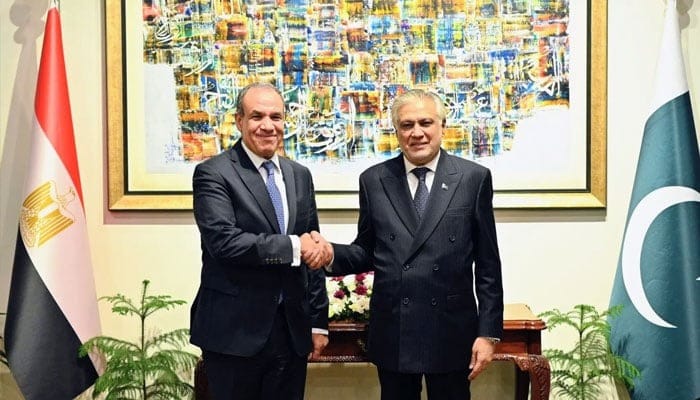
Pakistan Egypt have taken a major step toward strengthening bilateral trade, investment, and private-sector cooperation. During Egyptian Prime Minister Badr Abdelatty’s official visit to Islamabad, both nations agreed to deepen economic ties by expanding business linkages, improving market access, and enabling structured business-to-business engagement.
Deputy Prime Minister and Foreign Minister Ishaq Dar announced a strategic initiative: Pakistan will share a whitelist of 250 vetted business houses with Egypt, representing key economic sectors. This move is intended to accelerate B2B partnerships, support transparent commercial dealings, and increase bilateral trade volumes.
The plan reflects a renewed commitment from both governments to transform trade relations, which currently sit at approximately $300 million annually, and to explore new avenues in technology, agriculture, manufacturing, and other sectors of mutual interest.
Pakistan Egypt to Share 250-Business Whitelist With Egypt
According to Ishaq Dar, Pakistan will soon provide Egypt with a detailed list of 250 business entities that represent key sectors of the economy. This list will be compiled initially by the Federation of Pakistan Chambers of Commerce & Industry (FPCCI), ensuring participation from credible and experienced local firms.
How the Whitelist Will Work
- Pakistan finalizes the first batch of 250 business houses.
- FPCCI supervises the initial selection process to ensure representation across diverse sectors.
- Egypt conducts due diligence to verify potential partners.
- The vetted businesses form a jointly recognized Pakistan–Egypt whitelist, enabling faster cooperation, improved trust, and reduced bureaucratic delays.
- A second batch of another 250 businesses will be added within three months—bringing the total whitelist to 500 firms.
This structured approach is designed to eliminate ambiguity, reduce risk for investors, and significantly enhance the ease of doing business between the two countries.
Read Also Here: PM Shehbaz Sharif Receives Bahrain’s Highest State Award
Pakistan Egypt Business Council to Boost Private Sector Partnership
Another major breakthrough from the discussions was the creation of the Pakistan–Egypt Business Council. This council will serve as an institutional platform to:
- Facilitate private-sector dialogue
- Encourage long-term joint ventures
- Promote investment opportunities
- Strengthen sector-specific collaborations
- Ensure sustained engagement between key business leaders
- First Meeting Scheduled for 2026
The inaugural meeting of the Pakistan–Egypt Business Council is scheduled to be held in Cairo in the second quarter of 2026. This timeline reflects both countries’ intention to maintain continuity and momentum in commercial diplomacy.
Pakistan Egypt Improved Business Visa Mechanisms Discussed
One of the key obstacles businesses face is the complexity of cross-border travel and documentation. Recognizing this, ministers from both sides discussed ways to simplify business visa processes for entities included on the whitelist.
Streamlined visas will help:
- Enable more frequent business travel
- Support trade delegations
- Encourage investment exploration
- Reduce delays associated with documentation
- Build confidence among private-sector stakeholders
This is expected to significantly contribute to smoother operations and faster decision-making across sectors.
Expanding Bilateral Trade Beyond the Current $300 Million
Ishaq Dar highlighted the enormous potential for growth in Pakistan–Egypt trade, which currently stands at about $300 million. Both sides agreed that this figure does not reflect the true potential of their economic capabilities.
Key Areas Identified for Expansion
- Information Technology (IT)
- Agriculture and Agri-Tech
- Food Processing
- Pharmaceuticals
- Textile and Apparel
- Engineering and Light Manufacturing
- Automotive Components
- Construction Materials
- Tourism and Hospitality
Egypt has shown growing interest in Pakistani expertise in IT, skilled labor, agriculture, and export-oriented manufacturing. At the same time, Pakistani enterprises see opportunity in Egypt’s strategic location, booming construction sector, and expanding African-market access.
Egyptian Interest in Pakistani Sectoral Collaboration
Egyptian officials expressed keen interest in inviting Pakistani businesses to engage across multiple sectors. This includes:
- Technology outsourcing and software development
- Seed technology and crop research
- Export-oriented manufacturing
- Pharmaceutical production
- Textile supply chains
This cross-sector interest demonstrates that both economies are well-positioned to complement each other.
A Step Toward a Stronger Economic Partnership
This new phase of cooperation signals a long-term commitment to deepen economic integration. By establishing structured frameworks—such as the whitelist and the Business Council—Pakistan and Egypt are moving beyond traditional diplomatic agreements to actionable, measurable, and mutually beneficial initiatives.
The new mechanisms also ensure that businesses from both sides can pursue opportunities with greater trust, clarity, and institutional backing.
Historical Context: Pakistan Egypt Relations
Pakistan and Egypt have shared diplomatic ties since the early years of Pakistan’s independence. Both nations have cooperated in areas of:
- Defense
- Trade
- Education
- Cultural exchange
- Multilateral diplomacy
Historical collaboration includes membership in organizations such as the OIC and Non-Aligned Movement, supporting each other’s positions on global platforms, and promoting peace and development in the Muslim world.
Trade Relations Over the Years
Though historically modest, trade between Pakistan and Egypt has gradually expanded:
- In the early 2000s, bilateral trade hovered around $100–120 million.
- By the 2010s, it crossed $200 million.
- In recent years, trade has stabilized around $300 million, with potential for rapid growth.
This background underscores why the new whitelist initiative and Business Council are seen as transformative steps.
For official updates on Pakistan–Egypt economic cooperation, visit:
👉 https://www.commerce.gov.pk
FAQs
1. What is the Pakistan–Egypt business whitelist?
It is a list of 500 vetted businesses (in two batches) from Pakistan that will be shared with Egypt to boost B2B cooperation and trade.
2. Who is selecting the businesses for the whitelist?
The Federation of Pakistan Chambers of Commerce & Industry (FPCCI) will conduct the initial selection.
3. What is the purpose of the Pakistan–Egypt Business Council?
To institutionalize private-sector cooperation, promote investments, and support long-term commercial partnerships.
4. How much is the current trade volume between Pakistan and Egypt?
Bilateral trade is valued at around $300 million annually.
5. When will the first council meeting take place?
The first meeting is scheduled for Cairo in Q2 of 2026.
Read Also Here: